
LED flicker in NSW and QLD solved.
The definitive guide to Zellweger ripple control, why your LED lights flicker at the same time every day, and the four robust ways to fix it for good.
You are here because you searched for how to fix LED lights flickering, or because someone sent you this link. You almost certainly live in NSW or south-east QLD. The cause is well understood, and the solutions are clear once you know what to look for.

Same time every day? It is not your lights.
If your lights in NSW or QLD flicker at the same times each day, you are almost certainly seeing ripple-control (Zellweger) tones from the electricity network, not faulty fittings.
The signal sits at 750 to 1050 Hz on the 230V mains supply. The networks have used it since the 1950s to switch off-peak hot-water systems, street lights, and other controlled loads on and off. Incandescent and halogen lamps (appeared to) ignored it - In relaity we humans coul dnot see its impact but it was still occuring. Modern phase-dimming LED lamps cannot, they are made differently to tungsten and halogen 'light bulbs' and lamps, and they translate that injected tone into visible flicker, brightness jumps, or lights that never quite turn fully off - this last one being a different artefact of LED downlight dimming.
There are only a few robust ways out. The four below are listed in order of how well they hold up in practice.
Pick the strategy that fits the job.
None of these is a magic bullet. Each suits a different scenario. The summary cards below name the strategy, the conditions it works under, and where it sits in the toolkit. Detailed reasoning follows further down.
Stop dimming. Use switch only.
Any fitting that uses a replaceable LED lamp on a phase dimmer has a high chance of flicker in ripple-affected areas. Treat them as on or off circuits.
- Choose an appropriate wattage lamp to get a sensible light level without dimming.
- In commercial and hospitality spaces, accept these circuits are mood or accent light, not primary task lighting.
Use ripple-immune control gear.
Move from "any lamp on any dimmer" to fittings with dedicated drivers engineered to cope with a dirty mains waveform.
- DALI2 LED drivers handle dimming in the driver logic, not by chopping mains. Costly, needs DALI cabling and programming.
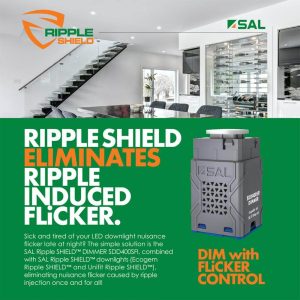
- SAL RippleShield / SFI downlights (UNIFIT, Ecogem, Coolum PLUS) plus the matched RippleShield dimmer eliminate 750 to 1050 Hz nuisance flicker as a system, with no special cabling.
Move dimming to the DC side.
With LED strip and a non-dimmable driver, dimming is done on the low-voltage DC side using a PWM controller, not by chopping the mains waveform.
- Far less exposed to small disturbances on the 230V supply.
- Generally much more stable in ripple-affected streets, assuming decent-quality gear.
Ripple filters help, not cure.
Filters from Gayrad, Thor and others can reduce the ripple tone before it reaches your lights. Useful, but not a guaranteed fix.
- Gayrad states their filters reduce the signal by 1/30th, not block it.
- Thor DRM750 / DRM1050 are described as designed to reduce or cancel, not guaranteed to eliminate under every load combination.
- Field reports show that even with a filter installed, some LED + dimmer combinations still flicker.
Low-risk advice for designing today.
Do not fight the physics with ever more filters on marginal products. In ripple-affected areas, avoid phase-dimming LED lamps (bulbs and globes) and instead either:
- Run them as switch-only.
- Switch to ripple-immune modules (DALI2 or RippleShield) where dimming is needed.
- Use LED strip plus DC-side PWM where strip suits the application.
The Australian Power Quality and Reliability Centre has published a detailed paper on ripple injection load control systems, covering the technical mechanism, network use, and impact on modern LEDs.
RippleShield + HCL: two outcomes, one system.
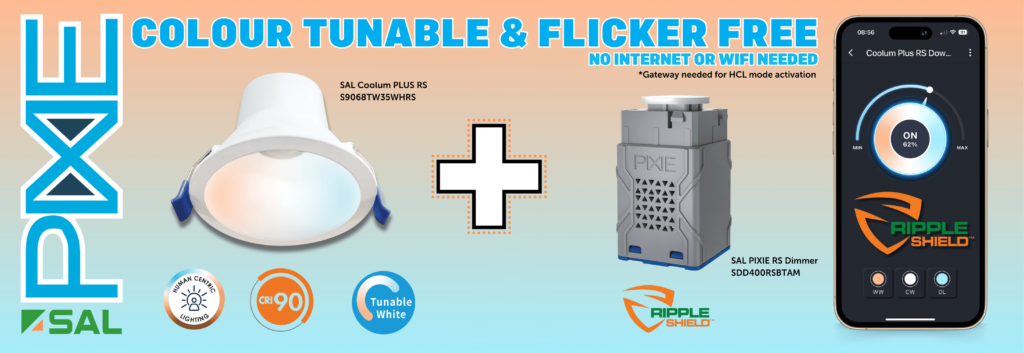
The SAL Coolum PLUS RS downlight paired with the matched PIXIE RippleShield dimmer eliminates 750 to 1050 Hz ripple flicker permanently, and adds Human Centric Lighting on the same fitting. It installs as a standard 2-wire trailing-edge dimmer with no neutral and no special cabling.
For readers trying to solve flicker today.
If your LED lights in NSW or Queensland flicker, pulse, or "breathe" at roughly the same times each evening, and especially if it gets worse the more you dim them, you are almost certainly running into ripple-control signalling, also known as Zellweger off-peak tones.
These are high-frequency signals (typically around 750 Hz or 1050 Hz) that the electricity networks superimpose on the 230V supply to switch off-peak hot-water, street lights, and other controlled loads. For decades those tones did not visibly bother anyone. Incandescent and halogen lamps ignored them, meaning the signal has been present since the 1950s without home users dimming ever noticing.
Modern LED lamps and many electronic phase dimmers do not. Their electronics can "see" the injected tone in the waveform and translate it into visible flicker, sudden brightness jumps, or lights that never quite turn fully off. Field reports from electricians in NSW and QLD, plus manufacturer and driver-vendor blogs, all tell the same story: phase-dimming LED lamps on a ripple-affected network is asking for trouble.
Officially, the problem is recognised
Federal lighting policy papers describe LED lamps flickering for a few minutes several times a day when ripple signals are sent to control off-peak loads, particularly in NSW and QLD. They note that "rectification and workarounds" are being handled by networks and lighting suppliers, and that a Ripple Control Working Group, with Lighting Council Australia, Energy Networks Australia, the University of Wollongong, and others, was formed to explore solutions.
As of 2025, no single national directive has emerged.
Despite early cross-industry discussions, the combination of cost, legacy network design, and regulatory priorities has resulted in Zellweger-induced LED flicker being treated as an accepted nuisance, to be managed at the installation level by lighting suppliers and electricians, rather than eliminated or comprehensively standardised at the network or regulatory level.
What that means in practice is that homeowners or facility owners need to pay more to eliminate flickering. Whether that is a DALI2 solution (often prohibitive, especially when discovered late in a project), RippleShield downlight swaps, changing the lighting control hardware for previously designated dimmable fixtures, or simply switching to non-dimming circuits, the cost falls on the property owner.
What does and does not work, brutally honest.
1. Phase-dimming LED lamps are a high-risk design choice
Any fitting that relies on a mains phase-cut dimmer plus a retrofit LED lamp (globe or bulb) is directly exposed to whatever the network injects onto the line. Whirlpool threads, AusElectricians posts, and direct field experience show that changing dimmer brand, lamp brand, or adding a generic "LED-rated" dimmer often only shifts the symptoms rather than removing them.
In ripple-affected areas, the safest recommendation is often to stop dimming those fittings entirely.
Run them switch-only, and if necessary adjust the lamp wattage and beam spread to get an acceptable light level at full power. In commercial and hospitality spaces, that may mean accepting that these circuits are decorative or ambience, rather than the primary task lighting that must meet code-mandated lux levels. Design the lighting scheme so non-ripple-sensitive circuits do the heavy lifting.
2. Move to ripple-immune fittings for dimming
Where dimming is non-negotiable, the more robust approach is to abandon the "any lamp on any dimmer" model and move to systems where the driver is engineered to cope with a dirty mains waveform. Note: the products below are not LED lamps (globes or bulbs that twist into batten holders). LED lamps are the primary type of light source that cannot reliably be dimmed without flickering in affected areas.
Option A: DALI2 LED drivers
Dimming is handled in the driver logic rather than by chopping the mains waveform.
The challenge is that the DALI2 driver and fixture cost more, and operating the system requires DALI bus cabling that has likely not been installed, plus commissioning by a dedicated DALI programming engineer.
Option B: SAL RippleShield / SFI
Specific downlights (UNIFIT, Ecogem SFI, Coolum PLUS) paired with a matched RippleShield / SFI dimmer. Designed specifically to eliminate nuisance ripple-induced flicker between 750 and 1050 Hz, the exact tone range used for off-peak control in NSW and SE QLD.
The advantage RippleShield has over DALI2 is that no special cabling is needed. Electricians change nothing in the cabling. There is a smaller range of downlight shapes and outputs to choose from, suitable for most people most of the time, but bespoke installations may find the choice limiting.
In other words, choose a system that has been tested as a system, rather than gambling on random lamp and dimmer combinations against a hostile network environment.
RippleShield in the showroom
The RippleShield display stand at SAL's showroom shows the matched system in action: dimmer plus downlight, side by side with a standard phase-dimming setup, on a circuit with simulated ripple injection. The difference is unmistakable.
3. LED strip with DC-side PWM dimming
For feature lighting, coves, back-lighting, and similar, LED strip with a non-dimmable driver and a PWM controller on the DC side is inherently less sensitive to small disturbances on the 230V supply.
The AC driver produces DC, and the PWM dimmer works on that DC feed. The mains waveform games are mostly handled inside the driver, upstream of the actual modulation of light output. Industry guides describe this as the simplest and most robust way to dim constant-voltage strip, separating mains disturbances from the dimming method.
See the PIXIE LED strip kit controller range →
4. Treat ripple filters as a tool, not a silver bullet
Yes, Zellweger and ripple filters from Gayrad, Thor, and others can help. They are specifically marketed to attenuate 750 / 1050 Hz ripple used for off-peak control, and can reduce symptoms across a whole circuit.
But the fine print matters:
- Gayrad openly state their filters do not completely block the tone, but reduce it by 1/30th of the original level. gayrad.com.au
- Thor describe their DRM750 and DRM1050 units as designed to reduce or cancel the effects of ripple, not as a guaranteed 100% cure under every load combination. thortechnologies.com.au
- Real-world user reports show cases where installing a ripple filter did not fully stop LED flicker, and the eventual fix was changing the fittings or control method instead.
Filters can help, and are sometimes enough. But they cannot be guaranteed to solve every LED, dimmer, and ripple combination. They are one part of the toolkit, not the foundation of your design.
The pattern is clear.
In 2025, there is still no neat, official one-page directive from government, Lighting Council, or the network operators that magically solves ripple-induced LED flicker. The pattern in the standards, policy documents, and field experience is consistent:
Do not fight the physics with more filters on marginal products. Change the control architecture.
The real fix is to design around the network as it actually exists, not as you wish it were. Switch-only, ripple-immune fittings, or DC-side PWM. Pick the strategy that fits the project, and leave the lamp-and-dimmer roulette to someone else.
Solving flicker on a project today?
The PIXIE RippleShield system is the most direct path for residential and small commercial work in NSW and QLD. The links below cover the product range, the technical detail, and the installer support behind it.